

What Is Synthetic Media an AI Content Guide
Discover what is synthetic media and how AI creates it. Our guide explains its uses in business, ethical questions, and the future of AI-generated content.
Table of Contents
You've probably heard the term synthetic media thrown around, but what does it really mean? Put simply, it’s any piece of content—an image, a video, a voice, or even text—that has been created or heavily modified by artificial intelligence.
Imagine a digital artist who can paint a photorealistic portrait without ever picking up a brush, or a musician who can compose a new track in the style of Mozart in seconds. That's the essence of synthetic media.
Defining AI-Generated Reality
At its heart, understanding synthetic media is about grasping a fundamental shift in how we create things digitally. We're moving away from merely capturing reality to actually generating it. Instead of a camera recording what's in front of it, an algorithm builds something entirely new, drawing on patterns it learned from analyzing millions of examples.
The result is content that can be so convincing it’s often impossible to tell apart from something made by a human. For a deeper dive, this guide on What Is AI-Generated Content is a great resource. The applications are popping up everywhere, from the movie industry to online shopping.
The key takeaway is this: Synthetic media isn't just about tweaking existing content. It's about algorithms creating brand-new, original content from scratch, one pixel or one word at a time.
To give you a better idea, here’s a quick look at the main types of synthetic media.
A Snapshot of AI-Generated Content
This table breaks down the primary forms of synthetic media and where you'll most likely see them in action today.
| Media Type | What It Is | Common Examples |
|---|---|---|
| AI Images | Still images generated by an AI from text prompts or other visual inputs. | Product mockups, virtual influencers, artistic creations. |
| AI Video | Moving images, including animations or realistic footage, created by AI. | "Deepfakes," animated avatars, virtual spokespeople. |
| AI Voices | Synthesized human-like speech that can mimic specific individuals or create new voices. | Voice assistants, podcast narration, character voices in games. |
| AI Text | Written content, from short snippets to long articles, generated by language models. | Chatbot responses, marketing copy, code generation, articles. |
Each of these categories represents a powerful new way to produce content, limited only by our creativity.
The infographic below offers another visual breakdown of how these different forms come together.
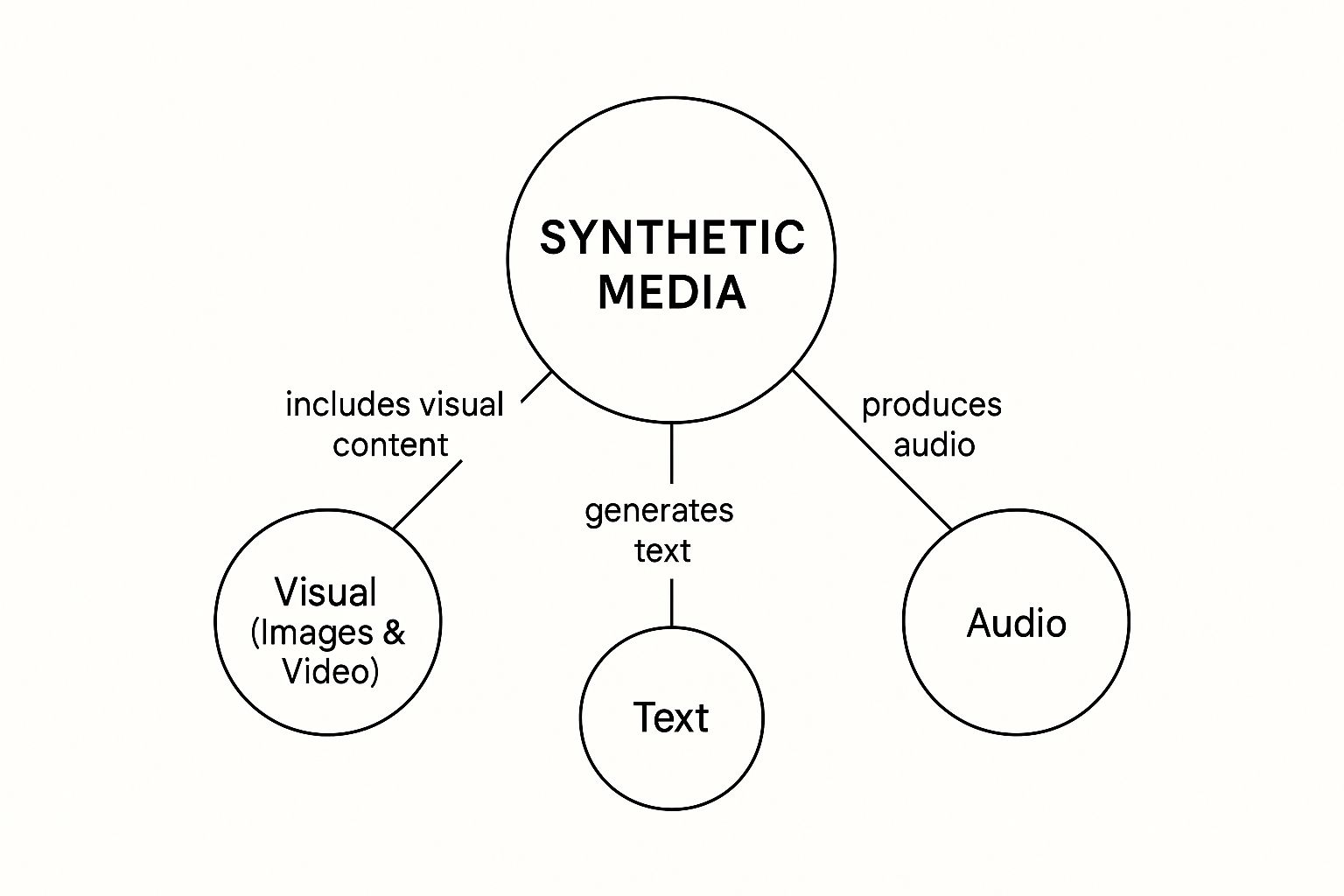
This visual really drives home how AI's creative reach extends across pictures, sounds, and words. Getting a handle on these categories is the first step to seeing how platforms like YourAIPhotographer put these tools to work.
If you're curious about how this is specifically changing the visual arts, take a look at our guide on the role of AI for photography.
How AI Actually Learns to Create Things
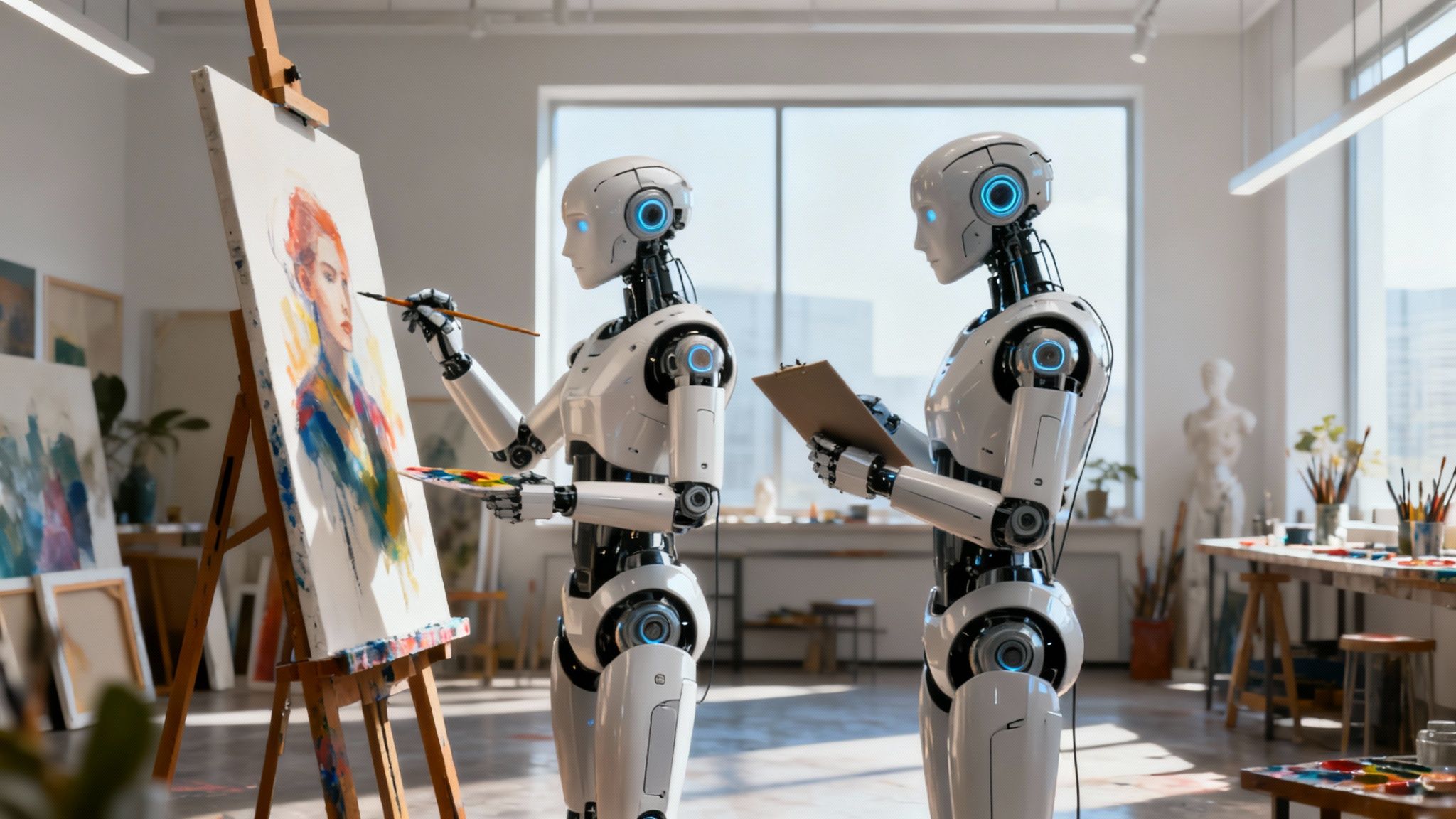
The "magic" behind synthetic media is really just a clever learning process, driven by some seriously smart AI. These models are fed enormous amounts of data—images, text, sounds—so they can figure out the patterns and rules that make up human creativity. One of the most common methods is called a Generative Adversarial Network, or GAN.
You can think of a GAN as a friendly competition between two AIs: a creator and a critic.
- The creator (or "generator") makes new images from scratch, doing its best to make them look authentic.
- The critic (or "discriminator") examines each one, trying to spot the fakes.
This cycle repeats millions of times. Every time the critic spots a fake, the creator learns and gets better. Eventually, the creator gets so good that its work becomes indistinguishable from the real thing. This is how AI can create a photo of a person who doesn't exist, yet looks completely real.
The Tools of Digital Creation
Another popular technique involves diffusion models. Picture an artist starting with a canvas full of random static, like an old TV screen with no signal. The AI has been trained on what a finished piece of art should look like, and it works backward, slowly removing the static layer by layer until a clear, detailed image emerges from the noise.
These powerful methods are the engines behind modern AI content. They're why an AI can write an email, compose music, or generate a professional headshot from just a few instructions. If you want to dive deeper, our guide explains how to train an AI model from the ground up.
By studying massive libraries of human work, these AI models don't just copy what they see. They learn the core principles of how to create, which allows them to generate something entirely new.
Better deep learning and computer vision have made synthetic media astonishingly realistic. For example, Microsoft Azure AI now offers real-time speech-to-text in 125 languages. Its text-to-speech service also saw a 50% jump in use from 2023 to 2024, which shows just how quickly businesses are adopting this tech.
How Synthetic Media Is Used Today
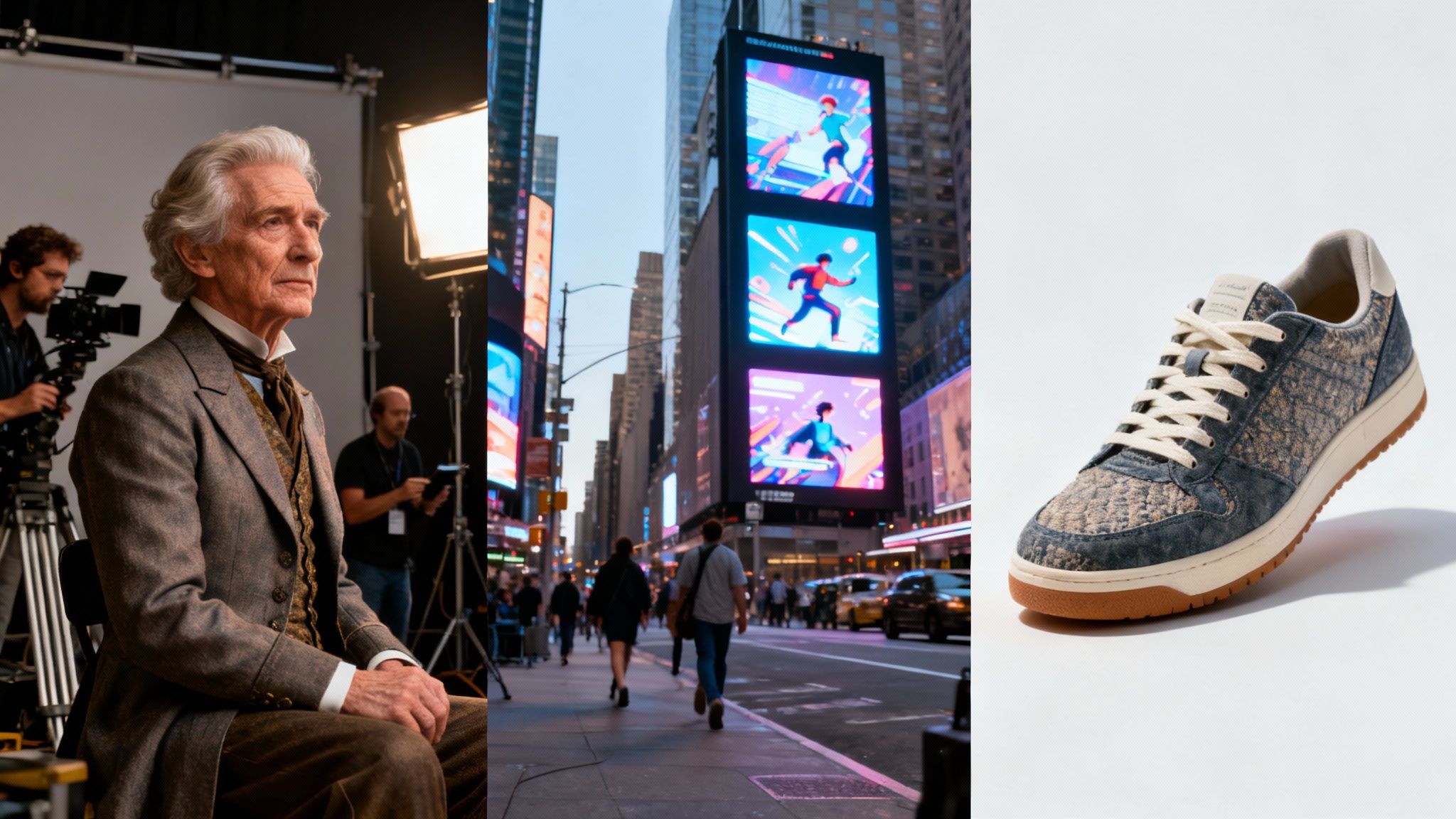
It’s one thing to understand the tech, but where is synthetic media actually showing up in our daily lives? The answer is: pretty much everywhere. It's already solving real problems and opening up new creative avenues for everyone from Hollywood directors to small online shop owners.
Take the entertainment industry, for example. Filmmakers can now realistically de-age actors for flashback scenes or even create digital characters from scratch. This doesn't just look cool; it dramatically cuts down on the costs of complex reshoots and lets creators build worlds that were once impossible to film.
The marketing world has also jumped on board. Brands can now create countless versions of an ad, each personalized for a specific audience, all without organizing separate campaigns. That level of customization used to be a massive drain on time and money.
Powering E-Commerce and Inspiring Creators
E-commerce is another field feeling the impact in a big way. Online stores can now generate stunning, professional product photos without the hassle and expense of a physical photoshoot.
Platforms like YourAIPhotographer give brands the power to create an endless stream of lifestyle shots, saving them thousands on studio rentals, models, and photographers. The entire process is quicker, cheaper, and way more flexible.
More and more industries are finding clever uses for synthetic media, and the growing number of the best AI video generator tools is making it accessible to everyone. This technology is no longer some exclusive tool for giant corporations.
Here are just a few examples:
- Virtual Try-On: A clothing brand can let you see how a dress looks on your body type, all without producing a single physical sample.
- Personalized Avatars: Companies can create AI brand ambassadors to handle customer support or engage with followers on social media.
- Social Media Content: Everyday creators are using AI to make unique profile pictures and jump on viral crazes. The hugely popular AI yearbook trend is a perfect example of this in action.
These examples make it clear that synthetic media is far more than a gimmick. It’s a serious tool for boosting efficiency, creativity, and personalization, and it's already delivering real results. By taking the heavy lifting out of content production, it frees up businesses and creators to focus on what really matters: the big ideas.
The Opportunities of AI-Generated Content
The buzz around synthetic media isn't just hype; it's fueled by some very real, very practical benefits for businesses and creators. We're already seeing a massive economic shift. At the end of 2024, the synthetic media market was valued at USD 4.96 billion, and it's projected to skyrocket to USD 16.84 billion by 2032. That kind of growth doesn't happen by accident. You can dig deeper into these numbers in this detailed report from SNS Insider.
The most immediate win? A huge drop in the time and money needed to produce high-quality content.
Think about what it takes to create a professional training simulation the old-fashioned way. You'd need to build sets, hire actors, and get a whole film crew on location. Now, a company can just generate a realistic virtual environment with AI avatars, slashing the budget and timeline.
Scaling Creativity and Personalization
Saving money is just the start. Synthetic media is also a massive force multiplier for creativity. A single designer can now generate hundreds of visual concepts in the time it used to take them to sketch just one. This opens the door for incredible experimentation, helping teams find the best idea faster.
By removing the friction from the creative process, AI allows ideas to flow freely. It handles the technical execution, freeing up human creators to focus on strategy, storytelling, and refining the vision.
This technology also makes personalization at scale a reality, something that used to be a logistical nightmare.
- For marketing: Brands can generate ad copy and images that speak directly to an individual's tastes, which is a game-changer for engagement.
- For e-commerce: A customer can instantly see how a couch would look in their own living room or how a shirt would fit a model that actually looks like them.
- For entertainment: Imagine an interactive movie that changes its plot based on your decisions, giving every viewer a unique story.
It’s easy to see why so many businesses are exploring different AI content creation tools to get ahead. Synthetic media isn't some far-off idea anymore; it's a powerful tool for anyone who wants to create better, faster, and more personal content.
Navigating the Risks and Ethical Questions
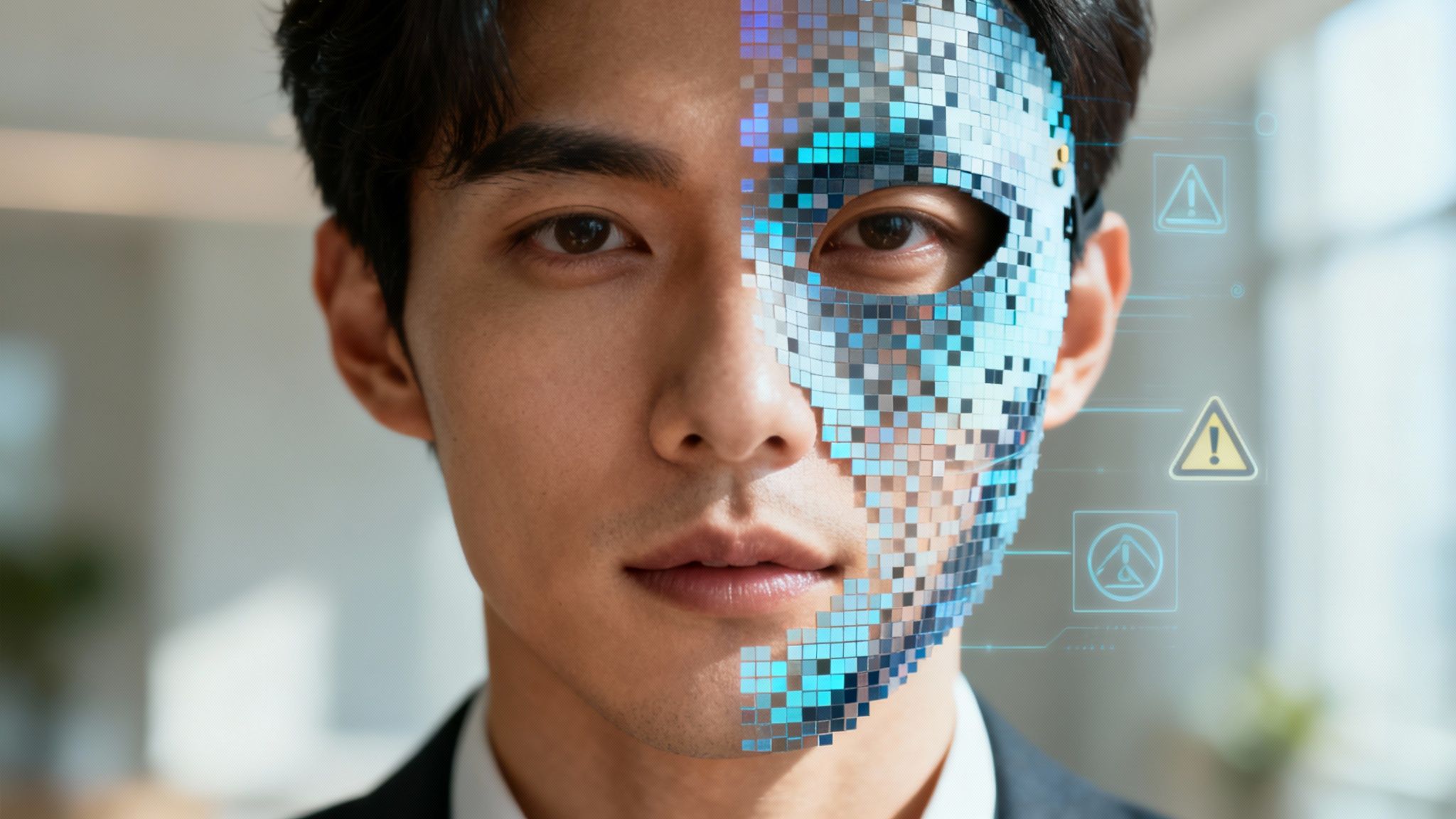
For all the incredible opportunities synthetic media opens up, it also brings some serious challenges to the table. We can't talk about this technology without facing the risks head-on, especially the rise of malicious deepfakes used to spread misinformation or even fake evidence.
These fabricated videos and audio clips can be shockingly convincing, making it harder than ever to trust what we see online. When a fake audio recording of a politician can spread like wildfire, it poses a genuine threat to public trust and individual reputations. This has sparked an arms race of sorts, with developers working tirelessly on detection tools to spot the fakes.
But the ethical questions don't stop at deepfakes.
Balancing Innovation with Responsibility
As AI starts creating more of our world, we're running into some tricky questions about ownership, privacy, and fairness. These aren't just abstract ideas; they directly impact how we use this technology responsibly.
Here are a few of the big ethical hurdles we need to clear:
- Copyright and Ownership: If an AI generates a stunning image, who actually owns it? Is it the person who typed the prompt, the company that developed the AI, or does it belong to everyone?
- Data Privacy: AI models learn from enormous amounts of data, which often includes personal photos and private information scraped from the internet. How we handle that data is a massive ethical concern.
- Algorithmic Bias: An AI is only as good as the data it's trained on. If that data is full of historical biases, the AI will learn and even amplify them, leading to stereotyped and unfair results in everything it creates.
The real challenge here is building trust. If synthetic media is going to be a force for good, the people and platforms behind it have to be transparent and stick to clear, responsible guidelines.
Figuring all this out is crucial for everyone involved. Knowing where the line is between creative use and harmful manipulation is especially important when you create AI photos of yourself for your career or just for fun. By putting ethics first, we can tap into the amazing potential of synthetic media while keeping the risks in check.
The Future of AI in Content Creation
So, where is all this headed? What is synthetic media actually becoming? Right now, we're seeing it shift from a fascinating new tool into something much more fundamental—a core part of how we create and interact online. The next wave isn't just about making better images or videos; it’s about crafting entire interactive experiences that feel pulled straight from a sci-fi novel.
Think about stepping into the metaverse and having a conversation with an AI character who looks and sounds indistinguishable from a real person. Or picture virtual influencers, completely computer-generated personalities, who are already building huge audiences and landing deals with major brands. This isn't some far-off fantasy; it's the very next step.
Making Creativity Accessible to Everyone
One of the most exciting things about this technology is how it opens up the world of high-end content creation. For a long time, making professional-quality media required expensive gear and a ton of specialized training. That's changing.
Now, with AI, anyone with a compelling idea has a shot at bringing it to life. A small business owner can produce a polished ad campaign, or a digital artist can invent entirely new visual styles without a Hollywood budget. The playing field is leveling out.
As businesses look for fresh ways to connect with people, the line between what's made by a human and what's generated by AI is getting blurrier by the day. The real draw of synthetic media is its ability to produce incredibly realistic, compelling content quickly and at a massive scale. To see just how fast this area is growing, take a look at this market intelligence report.
Synthetic media is more than just an advancement in technology; it's a new form of communication. It represents a fundamental change in how we tell stories, share information, and connect with each other.
At the end of the day, this technology is a blank canvas. It gives us a powerful new way to express ideas and build worlds. From entertainment that's personalized just for you to art forms we haven't even imagined yet, the AI-driven future is shaping up to be more engaging and creative than we ever thought possible.
Got Questions About Synthetic Media? We’ve Got Answers.
As you dive into the world of AI-generated content, you're bound to have some questions. It’s a fascinating and fast-moving field, so let's clear up a few common points.
So, Are Deepfakes the Same as Synthetic Media?
That's a great question, and the simple answer is no. Think of it this way: a deepfake is just one specific, and often infamous, type of synthetic media. It’s typically a video where someone’s likeness is convincingly swapped, often for malicious reasons.
But synthetic media is the whole universe of AI-created content. It includes everything from helpful AI avatars that guide you through a website, to AI-composed music, and even the virtual product photos you see in online stores. While deepfakes get all the headlines, they're just a tiny slice of a much bigger, and mostly positive, picture.
How Can I Spot AI-Generated Content?
It’s definitely getting trickier, but there are still some tell-tale signs if you look closely. Keep an eye out for small oddities—hands with the wrong number of fingers, weirdly blended backgrounds that don't quite make sense, or just that subtle "uncanny valley" feeling where something looks almost real, but not quite.
The good news is that many companies are working on solutions. Digital watermarks and sophisticated AI detection tools are being developed to help us all tell what’s real and what’s not.
Is This Stuff Hard to Use?
Not at all! The days of needing a computer science degree to create with AI are long gone. Today, there are tons of powerful yet incredibly user-friendly tools out there for everyone. You can find platforms to generate professional voiceovers, write marketing copy, or create stunning images just by typing a few words.
The best way to get started? Pick one thing you want to make easier—say, creating cool visuals for your social media—and then find a tool built for exactly that. You'll be surprised how simple it is.
Ready to create amazing, AI-generated photos without any of the hassle? With YourAIPhotographer, you can transform a few simple selfies into professional headshots, lifestyle images, and creative portraits in minutes. Check out our Photo Packs and start creating today